€10 credit on 2+ art prints in my shop

5 Incredible Historical Sites on Crete: Western & Central Crete

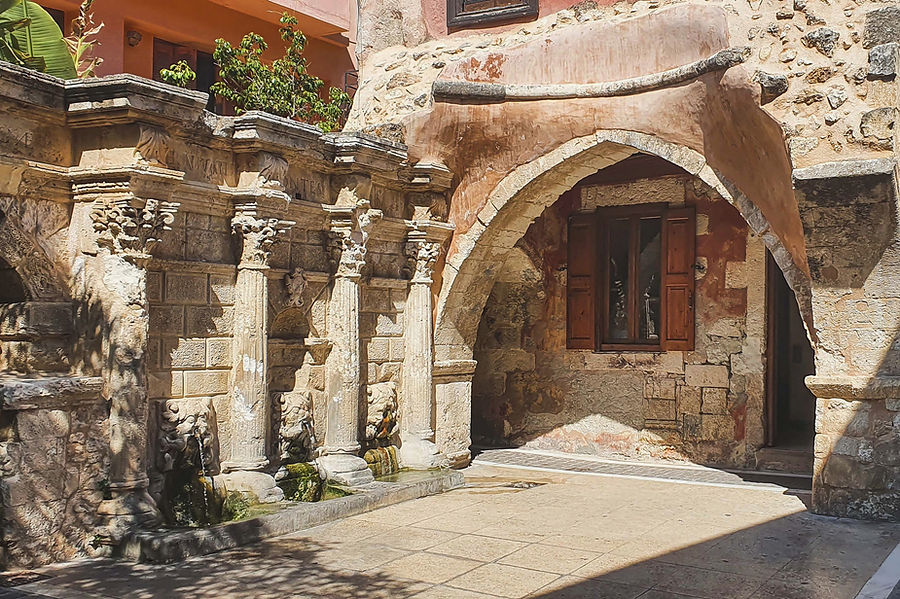
The Rimondi Fountain in Rethymno is one of many historic landmarks on Crete
Crete, Greece’s largest island, has a rich cultural heritage shaped by its unique location between Europe, Africa, and Asia. Over thousands of years, the island has been influenced by civilisations ranging from the Bronze Age Minoans to powerful empires of later periods.
When I visited Crete as an artist inspired by Mediterranean heritage, I couldn’t help but wonder what the island had to offer beyond its sun-drenched beaches and azure waters.
During my two-week stay in Crete, I set out to discover some of the island’s most fascinating historical places, exploring ancient ruins, scenic monasteries, and charming old towns along the way.
This guide will take you to my five favourite historical sites in western and central Crete, offering a well-rounded journey through the island’s fascinating cultural heritage.
1. Rethymno’s Old Town: Fortress and Sea Views
Rethymno, located on the northern coast of western Crete, is the third-largest city on the island, boasting a fascinating old town and a historic harbour. Thanks to its strategic coastal location, it became an important centre for trade and military activity, leaving behind a rich mix of cultural influences from various civilisations.
Among these influences are the Venetians, who ruled Crete from the 13th to the 17th century. The Ottomans also shaped the town, an empire originating in modern-day Turkey that later succeeded Venetian rule. Together, these influences left a lasting mark on Rethymno’s architecture, shaping the unique historical character of the town.
VENETIAN HARBOUR
Shaped by Venetian-style architecture, this area once served as a centre for trade and maritime activity and still defines the city’s coastal character today.
RIMONDI FOUNTAIN
A charming Venetian-style fountain in the old town. With its Corinthian columns and characteristic pointed arch, it's one of Rethymno’s most distinct landmarks.
FORTEZZA
A vast Venetian fortress built on a hill overlooking the city. The sea views from here are breathtaking!
IBRAHIM HAN MOSQUE
Located within the Fortezza, this former church was later converted into a mosque during Ottoman rule. Inside, the impressive dome is decorated with intricate mosaics.
2. Chania's Old Town: Venetian Harbour and Coastal Charm
About an hour’s drive from Rethymno, Chania is built on the site of ancient Kydonia. It became an important centre of the Minoan culture, one of Europe’s earliest advanced civilisations.
However, it’s the Venetian and Ottoman heritage that is most visible in Chania today, particularly around the picturesque Venetian harbour.
Beyond its historical landmarks, Chania’s narrow streets, lined with colourful doors and lush greenery spilling from terracotta pots, are a true delight to explore.
VENETIAN SHIPYARDS
Long stone halls once used as workshops for shipbuilding and repair. Their historic façades still shape the harbour today and reflect Chania’s maritime past.
FIRKA FORTRESS
With its massive walls and strategic position by the harbour, this Venetian fortress once served as a key defensive structure protecting Chania from attacks.
HASAN PASHA MOSQUE
With its central dome surrounded by smaller domes, this Ottoman mosque is a distinctive landmark that still defines the harbour skyline today.
CHURCH OF AGIOS NIKOLAOS
One of the few churches in Greece featuring both a bell tower and a minaret. Originally built as a Christian church, it was later converted into a mosque and is now used as a church again.

Join the mailing list and be the first to discover the following highlights:
1. My latest inspiring travel stories
2. New Mediterranean art for your home
3. Limited editions & travel journals
3. Arkadi Monastery: Crete’s Symbol of Resistance
When entering the courtyard of the Arkadi Monastery — dotted with roses, vines, and olive trees — one can barely imagine the struggles for independence that once unfolded here. Set on a hill overlooking a serene valley, the tranquil Cretan monastery features an ornate church surrounded by the monks’ living and working quarters.
In 1866, Arkadi Monastery became the site of a fierce confrontation: the Cretan population rose up against Ottoman rule.
Hundreds of locals sought refuge inside the monastery, where they were later attacked by Ottoman forces. The last survivors retreated into the monastery’s gunpowder room and chose to ignite the stored gunpowder rather than surrender. The room can still be visited today, with its roof destroyed in the explosion.
Personal travel note: I’ve added a Google Maps link marking the exact Arkadi Monastery location.
4. Palace of Knossos: Crete's Cradle of Minoan Culture
Knossos was one of the most important Minoan palace complexes in Crete. The courtyards, the throne room, and the impressive frescoed walls give a vivid sense of how ancient Cretan civilisation lived around 3,000 years ago.
Knossos is particularly fascinating when viewed through the myth of the Minotaur: according to legend, King Minos had a labyrinth built beneath the palace, where the creature was held captive. The Athenian prince Theseus eventually defeated the Minotaur with the help of Ariadne, the king’s daughter.
Personal travel note: Knossos has undergone heavy restoration, which gives a vivid impression of Minoan life. But if you’re looking for something more authentically Cretan after Knossos, follow me to the next sight …
5. Palace of Phaistos: A Hidden Gem of Central Crete
Phaistos is another Minoan palace set on a hill above the Messara Plain – Crete’s largest fertile valley. Its terraces and courtyards offer seemingly endless views of olive groves and vineyards, while its stairs and passages lead through the remains of the ancient palace’s chambers and halls.
The historical site is also known for the Phaistos Disc – a mysterious clay disc covered in symbols that remain undeciphered to this day.
Phaistos is best experienced through its atmosphere, as there are few fully preserved rooms, halls, or colonnades. While wandering across limestone steps, cicadas hum in the pine trees, and the landscape reveals the timeless beauty of central Crete.
Personal travel note: You can easily visit Knossos and Phaistos in one day. Knossos gives you a very concrete impression of Minoan culture, while Phaistos leaves more room for imagination.
Exploring Crete’s Cultural Heritage
Crete offers more than sun-drenched beaches and azure waters. Its rich historical heritage is what sets a stay on Crete apart from stays on many other Mediterranean islands, revealing a layered and diverse side of Greek culture.
As an artist, I remember Crete’s historical places for their eclectic frescoes, ochre and red tones, and distinctive architecture. I also loved discovering the island’s fascinating myths and mysteries, from the legend of the Minotaur to the undeciphered Phaistos Disc.
And who knows — perhaps one of my Mediterranean-inspired paintings will take you even further on your journey. A golden sunset in Rethymno has definitely found its place in my art collection.
Essential Tips for Your Stay in Crete
1. When is the best time to visit Crete?
Crete is an ideal summer destination, where high temperatures feel more comfortable than in much of the Mediterranean due to the rather dry air.
2. How long should you stay in Crete?
At least a week is ideal to savour Crete’s sunny weather and explore a few of its most remarkable historic sites, allowing time to combine relaxation at the beach with sightseeing.
3. What’s the best base town in western Crete?
Great base towns in western Crete are Chania and Rethymno. Both offer stunning beaches as well as charming old towns to explore.
4. Which is more beautiful, Chania or Rethymno?
Chania offers more sights than Rethymno, but in terms of atmosphere both towns are similar. Rethymno’s location is advantageous for day trips to both western and central Crete.
More Crete guides will be added soon.


All texts and images on this website are protected by copyright and may only be used, published, or used commercially with the consent of the artist. The content is provided for informational purposes only, with no guarantee of accuracy or completeness. Independent verification is recommended.